


18 Jul Gear Roundup (Part 1)
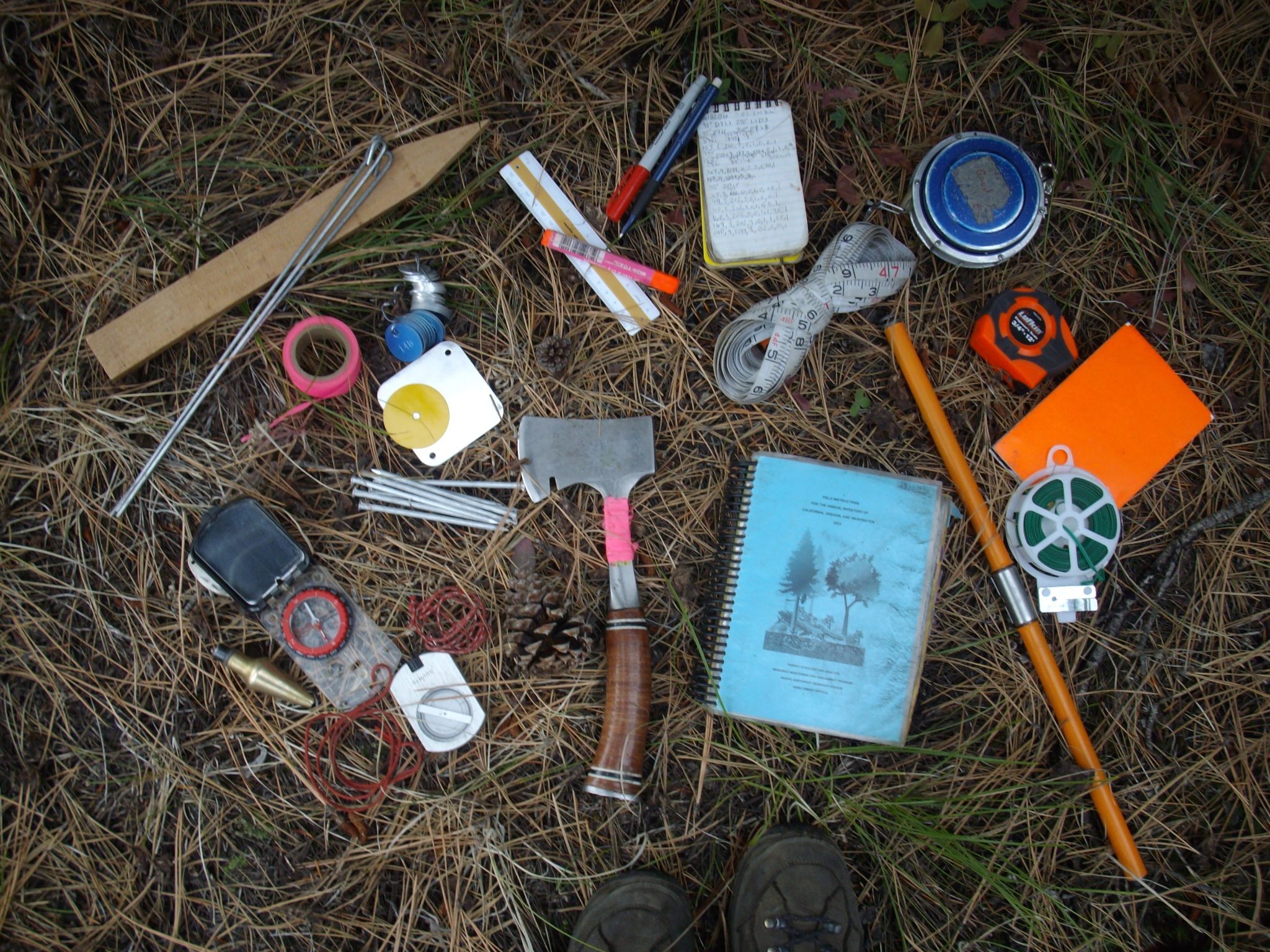
Time for a tool roundup! Here is a look at the gear I carry with me into the field (pictured above):
• Wooden Stake: This is how we mark the center of the first subplot. After adding some monumentation and flagging we replace the stake installed at the previous visit so it’ll be visible for the next crew in 10 years.
• Pins: We use these to mark plot center on subplots 2-4, as well as the microplot centers on all four subplots. I also use these to secure some of my other gear and take measurements without needing another set of hands.
• Flagging: A staple in any field crew, we use flagging to mark all pins and stakes, as well the end of our transects so the Quality Analysis team can check our work if they come out to check our plot.
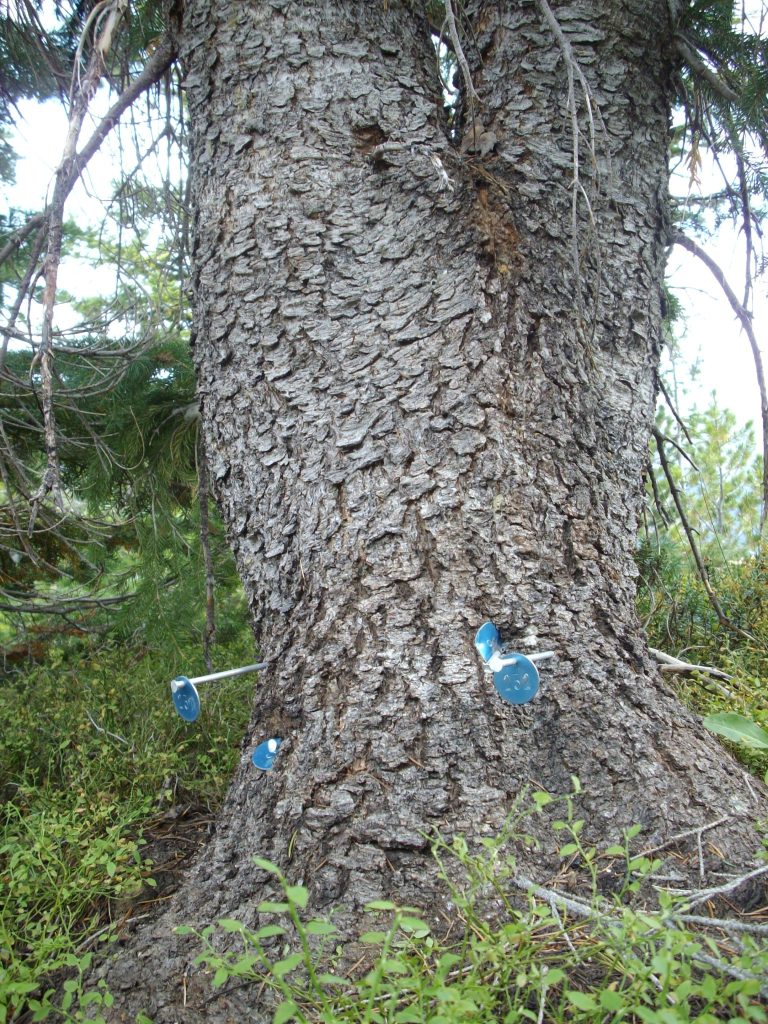
• Tree numbers: Using nails we attach numbers to the base of each tree we tally so we can tell which tree corelates to which historical data (though, if a tag gets swallowed by an ambitiously growing tree, we use distance and azimuth to confirm).
• Squares: How we mark witness trees on subplot one for future crews to use as references. Extra data are collected for witness trees so they can be used to find the plot center if the wooden stake isn’t there on the next visit.
• Rounds: These are double-sided and have quite a few uses. Similar to squares, we use them to mark the witness trees, however we use these on subplots 2-4 and leave the squares unique to subplot one/plot center. We also use them in tandem with the pins, thread a white round on the pin for the microplot center and a yellow round for the subplot center.
• Nails: Another field staple, this is how we attach the tree numbers and other monumentation to trees, as well as how we mark where we measured the diameter of the tree (the standard is 4’6” from the base).
• Compass: Maybe my most used tool; we use coordinates from the previous crew and a GPS to get the rough distance and azimuth to plot center, use it to guide us to each subplot, confirm witness trees, and set up transects.
• Plumb bob: Helpful for getting an accurate horizontal distance on an uneven slope.
• Clinometer: This is how we measure the slope of each subplot, both for the data and to convert slope distance to horizontal distance (I have a cheat sheet taped to the back of mine with common conversions).
• Hatchet: Sometimes this feels more like a multi-tool, at times acting as a hammer to place or remove nails, a shovel to dig a soil pit in addition to a hatchet to check the tree for root disease or decay.
• Ruler: For measuring the duff and litter heights in your soil pit and tree cores ages.
• Crayon: For marking the diameter height on saplings who are too small for nails or a piece of coarse woody debris that intersects your transect
• Notepad/pens: I mainly use this to jot down transect data until I can enter it into the data recorder, but also if I get a jump on measuring trees while the data recorder is still in use elsewhere (pro tip: rite-in-rain paper is great, but don’t use a gel pen unless you want smeared ink on everything including yourself)
• Cloth tape: Transects transects transects! I use a pin to attach it at the center and measure out 24ft along the correct azimuth to dig a soil pit, and act as a guide for where to measure coarse and fine woody debris. along that line.
• Field manual: The ultimate authority on all protocol and codes. I reference this nearly every day, inside the office and in the field, to answer questions about unusual situations (or, for when I forget things). We’d be lost without our manuals!
• Increment bore: How we collect tree core samples to measure age and growth index (i.e. growing conditions and tree health)
• Ancillary wire: Another alternative to using nails on saplings, hanging monumentation (numbers, rounds, squares) from the branches instead.
• Flasher: We use lasers to measure tree heights (good thing too, since my trigonometry is a bit rusty), but sometimes it’s hard to get a clear shot through the brush. Reflectors help the lasers get accurate readings.
• Carpenters tape: Has a variety of uses, but most often used to take vertical measurements (stump/sapling height, length to diameter measurement) or substitute a cloth tape if there is a lot of brush in the area. Fun fact: We measure in 10ths of a foot rather than the typical 12in/ft.
• Logger’s tape: One of my favorite pieces of gear, the increments already account for the conversion from circumference so it’s a breeze to measure tree diameters. It’s also an easy way to measure distances, since it’s clipped to your belt or vest. If a fellow crew member is standing on subplot center you can just grab the end of their tape and walk to where you need while they’re working on another task.
And that’s it! We keep all this gear in a combination of vests and belts, but these are the basics. In addition to what is shown here, we also carry first aid kits lunch, water, layers, and whatever other supplies we personally want. There is also a variety of electronics to use on plot, but I’ll explain all of that in another entry. Until then, Thanks for reading and stay tuned for more!
Sorry, the comment form is closed at this time.