


27 Feb Birds & Beans
Wake up and smell the conservation
Did you know you can promote bird conservation efforts while getting your caffeine fix each morning? How? By choosing to buy certified shade-grown bird-friendly coffee.
Some estimates show up to 400 million cups of coffee consumed each day in the United States alone, so it’s no surprise that coffee farms are having an impact on the habitats of birds. Migratory birds have a long journey to make each year, and many of them will stop to rest in countries where native habitat has been sacrificed for the expansion of coffee farms. But these coffee farms can still support a rich avian population when they grow their coffee in the shade of native plants that mimic natural forests. That’s why we at Environment for the Americas (EFTA) are encouraging coffee lovers everywhere to make choices that help protect birds and their habitats.
Not All Beans Are Created Equal: What is shade grown coffee?
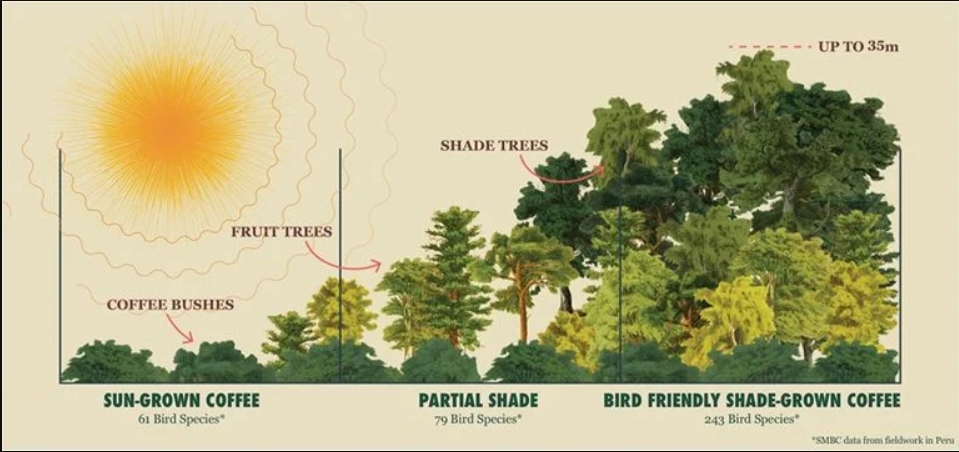
Shade grown coffee is coffee grown under the shade of a canopy of other trees. However, which trees make up that canopy is just as important as the shade they provide. The Smithsonian Institution developed its Bird Friendly coffee certification in 1996 to encourage “a mix of foliage cover, tree height, variance that creates quality habitat for birds and other wildlife.” This practice is called agroforestry, and it’s where coffee is grown in concert with a full canopy of native trees to support conservation efforts. Here’s a brief comparison of sun-grown and shade-grown coffee practices:
Sun-grown | Shade-grown |
Coffee grown in full sun | Coffee grown in partial or full shade |
Monoculture (Single crop) | Many plant species, some native |
Beans ripen quickly | Beans ripen slowly |
Higher crop yield – often why this method is chosen | Lower crop yield |
Rely on pesticides | Natural pest control by birds – pesticide use varies if not organic |
Limited bird diversity | Supports diverse bird populations |
Birds of a Feather Flock to Better Coffee
While the trees at sun-grown coffee plantations may provide a habitat for some birds, many of these birds are specialists requiring a very specific habitat. Bird -Friendly shade-grown coffee farms incorporate a variety of native species in different shapes and sizes.
Read on for some examples of how different levels of a forest-like coffee plantation can serve the needs of a variety of migratory species.
- Upper canopy: The Chestnut-sided Warbler can be found in the uppermost layers of the coffee farm, picking insects off the undersides of the leaves of the shading plants that give shade grown coffee its name.
- Above the coffee: The Eastern Wood Pewee snacks on flies from its perch above the coffee plants, a natural insecticide.
- Among the trunks: The Black-and-white Warbler eats insects off the bark of trees it encounters whilst traversing their trunks and branches.
- The Forest Floor: The Wood Thrush forages for insects hidden amongst the leaves and other detritus that have fallen from the coffee plants and trees above.
It’s easy to see why Bird Friendly coffee farms have some of the greatest migratory bird variety in the world.
Flavor that Takes Flight
These forest-like farms don’t just benefit the birds. The shade they provide slows the ripening of the beans resulting in bolder, richer, more complex flavors. Scientists and coffee connoisseurs agree. Who knew bird conservation could be so delicious?
In addition to better flavors, the trees at these farms benefit the environment in myriad ways. These include:
- providing homes for more wildlife beyond birds
- preventing erosion
- increasing pollination
- storing carbon that might otherwise contribute to global warming
Brewing a Better World: Your Turn
- Choose the right coffee
- Buy Smithsonian Bird-Friendly certified shade-grown coffee. Farms with this certification must have:
- at least 40% shade cover
- at least ten different tree species
- at least 60% native plants
- a canopy at least 12 feet tall
- Try EFTA’s Early Bird blend from Ampersand Coffee Roasters in Boulder, CO – it’s organic, fair trade, and bird-friendly meaning it not only helps the birds but also the communities choosing bird-friendly practices.
- When bird-friendly isn’t available
- Look for other seals like “Rain Forest Certified” for farms that use sustainable best practices.
- Look for “relationship coffees” – check the packaging of smaller roasters for those that have formed relationships with local communities that use sustainable farming practices.
- Buy organic to encourage reduced use of pesticides.
- Choose arabica over robusta – though this is not a reliable way to distinguish, arabica beans are more likely to be farmed sustainably than robusta.
- Consider the origin country – coffee from India, Ecuador, and Peru is more likely to be shade-grown than coffee from Brazil and Vietnam.
- Advocate for change
- Ask local coffee shops to offer bird-friendly options.
- Share information about shade-grown coffee with your community.
- Join our March 20th webinar featuring Smithsonian Institute expert, Ruth Bennett, who specializes in conservation in tropical forests and agroforests.
Sources
About Bird Friendly Coffee | Smithsonian’s National Zoo and Conservation Biology Institute
Bird Friendly | Smithsonian Tropical Research Institute
How can coffee plantations be more bird-friendly?
How to Choose a Bird-Friendly Coffee | Audubon
Slower development of lower canopy beans produces better coffee – PMC
Sorry, the comment form is closed at this time.