


24 Jul Bee Projects in Progress
While Tuesdays are reserved for field days and Nest Quest takes up half a day every other week, the rest of the time I get to work on a range of projects in the office with more in the works! Here are a few of the things I’ve been working on so far:
The Rusty Patched Bumble Bee Buzz
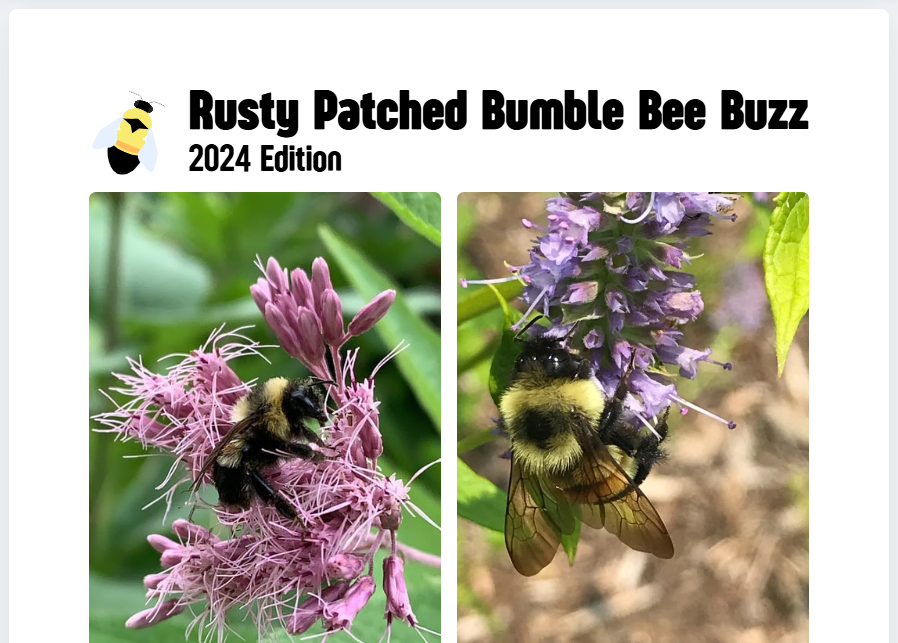
Since listing, more and more research, policy, outreach, and funding efforts are underway in support of the federally endangered rusty patched bumble bee. I have been working on a newsletter that will highlight the work and accomplishments from 2024 and serve as a template for future updates. This newsletter, The Rusty Patched Bumble Bee Buzz, will go up on the rusty patched bumble bee page on the FWS website and cover a year of population trends, science updates, policy and conservation news, education and outreach work, and habitat restoration and creation.
Rusty Patched Bumble Bee Nest Paper
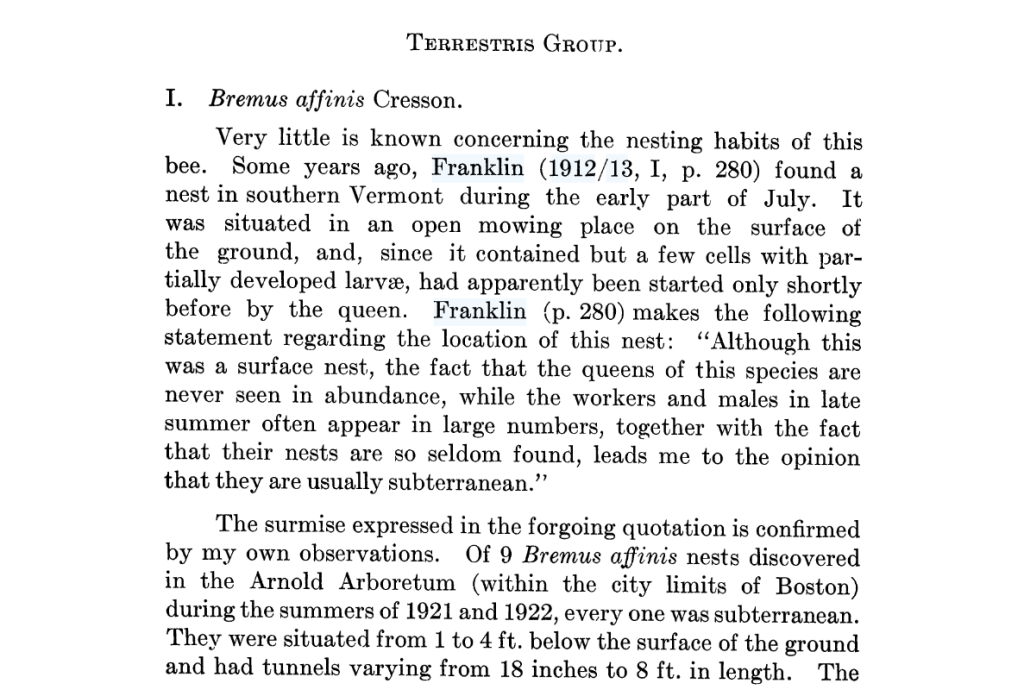
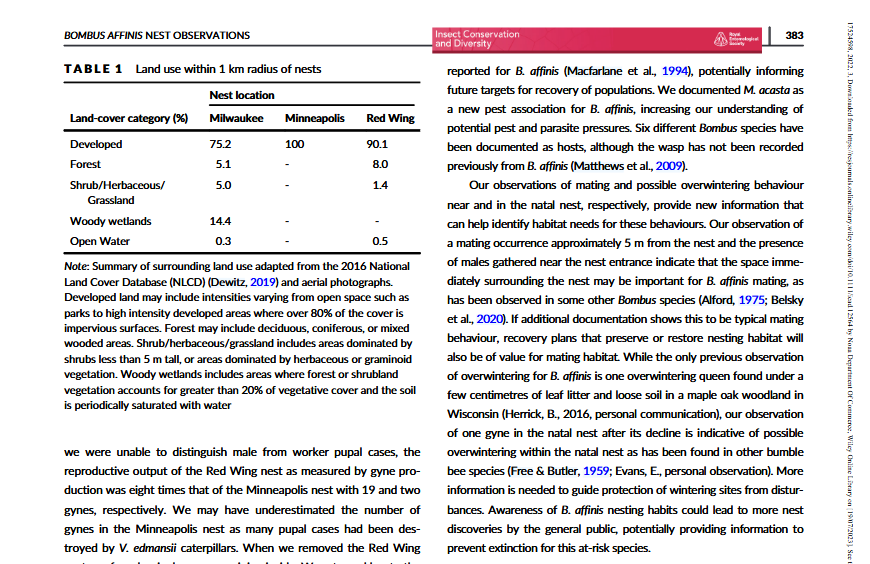
When it comes to bumble bee nesting, there is a lot we don’t know. Nests are difficult to find and, while we have some data, we don’t know exactly where to look either. In addition to participating in Nest Quest, a UMN project aiming to collect data on bumble bee nests in general, I am also working with my FWS supervisor, Tamara Smith, to analyze data on rusty patched bumble bee nests specifically. I’ve been reading papers from as far back as 1922, looking to document a range of data collected on nests found between 1912 and 2024. The contrast between modern and historical papers is wild. Scientific writing has come a long way, from the speculative, poetic musings of 1922 (top, Plath 1922) to the compact, data-rich prose of a 2022 nest excavation (bottom, Boone et al. 2022). One trend I didn’t expect that has been documented in multiple species is an association with rodent burrows. From what I’ve read so far, it seems like bumble bees may gravitate towards the abandoned burrows of chipmunks and other rodents to the point that some sources suggest leaving nesting boxes in the woods before use to let mice nest in the box and make the habitat more attractive to bumble bees. In addition to rodent activity, I’m also looking at land cover, bumble bee community, nest observation, pollen samples, bee body condition, genetic samples, pest and pathogen presence, and if the nest was able to be excavated.
Solitary Bee Hotel
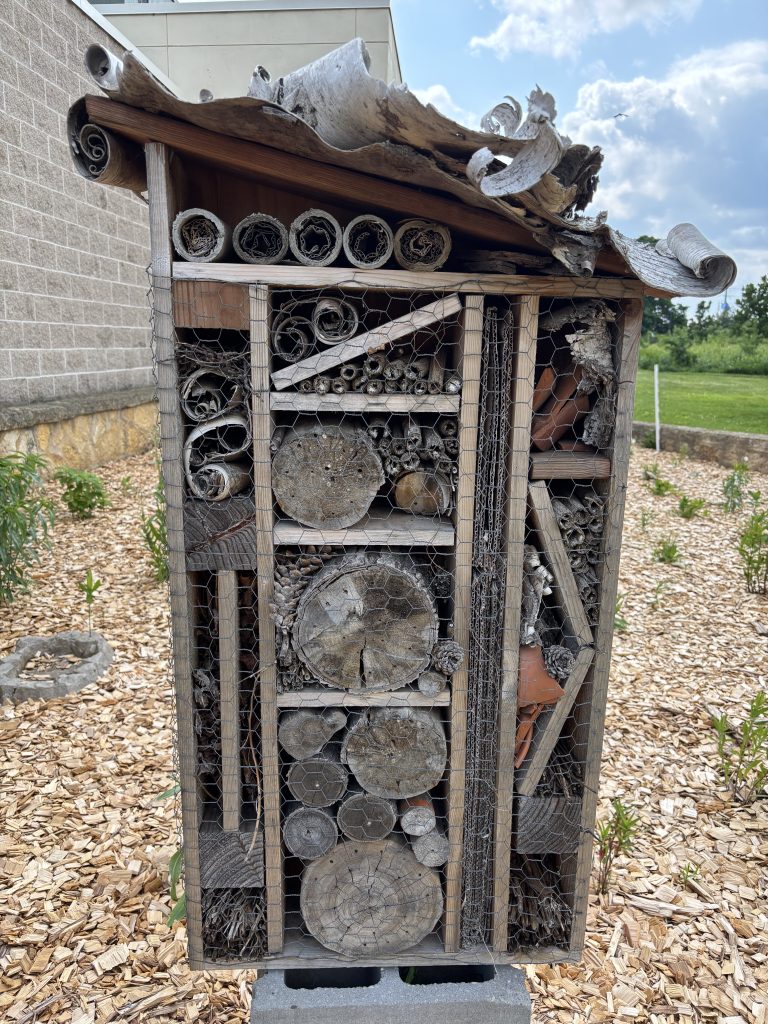
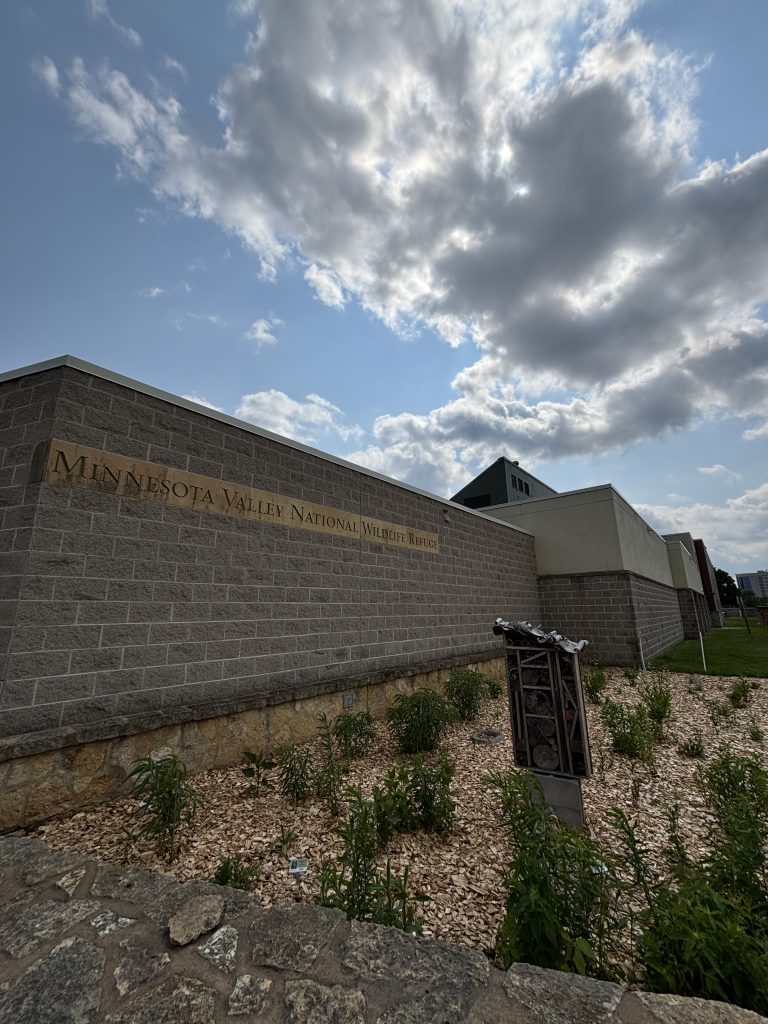
You may have seen bee hotels for sale at home improvement stores or garden centers. These tend to be set-it-and-forget-it bird house-like structures that aim to attract solitary bees and wasps. While it’s great that more people are supporting their local pollinators, these structures can become harmful if not properly constructed or taken care of. For example, the refuge’s current bee hotel (left) is large, facilitating the spread of parasites and pathogens between nesting tunnels. It has rough-edged reeds and stems that could damage a bee’s wings, the holes drilled into logs may harbor parasites and harmful fungi after multiple seasons, the pinecones, cardboard, and other materials that aren’t bee-sized tunnels could attract predatory occupants, and there is no sheltered space for bees to develop and emerge safely. Additionally, there are only a few tunnel sizes and the whole structure is relatively shallow and low to the ground. As solitary bees construct their nests back to front, they lay larger female eggs on a ball of pollen and nectar, seal it off, and work forwards, laying smaller male eggs as they reach the open end. Small, short tunnels may lead to male-skewed broods which negatively impact the overall population. Lastly, this bee hotel has been in place for some time and, as you may be able to make out in the photo, has been unsuccessful in attracting any bees or wasps.
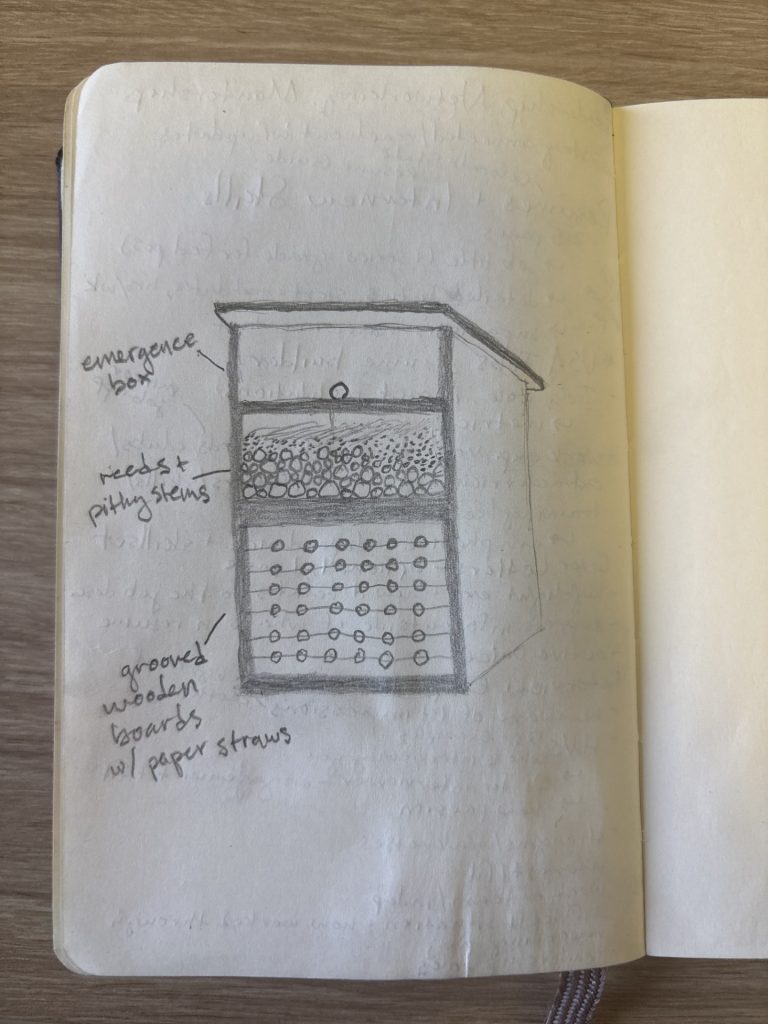
With help from others in the office, we are going to construct two smaller bee hotels like the sketch (left) and I’ve written a maintenance guide to ensure the hotel is properly cleaned and cared for after each season. The new structure will have three compartments. Removable grooved boards with paper straws will occupy in the lowermost compartment. At the end of each season, the boards will be taken out and disinfected and the paper straws will be removed and replaced with fresh ones, minimizing the spread of mites and fungi. The middle compartment will have reeds and pithy stems of a more appropriate length that range in diameter and we will make sure all materials have smooth edges. These tunnels can be easily removed when cracked or weathered and replaced with fresh ones each season. The top compartment features an emergence box under a hinged roof where we can put occupied paper straws, reeds, and stems over the winter. There is a hole the size of the largest tunnels at the front for newly-emerged bees to crawl out of when they are ready. The new bee hotel will not have any pinecones, cardboard, or terra cotta shards as these are not nesting materials used by solitary bees or wasps. I’ve but a lot of work into planning this renovation, so I’m excited to build these structures and hopefully next season’s bees appreciate the effort!
Views from the Field
Sorry, the comment form is closed at this time.