


28 Jul Birds and Belonging: Our Final WMBD Event at the Dunes
Hi everyone! Karli here again for my next blog entry!
Introduction
Before reading on, I recommend checking out my fourth blog post, where I introduced World Migratory Bird Day, our outreach process, and our pilot collaboration with Paladin. That background provides helpful context for what I’m sharing today.
So, this last Friday, we had our main (and final) World Migratory Bird Day event for the summer at the Paul H. Douglas Center. First things first–I’d say the event was a success overall. This time, we had two organizations attend: Paladin, which sent a group to our pilot event, and Opportunity Enterprises. Before I get into the event details, I want to talk more about each organization.
Collaboration

I spoke about Paladin in my last blog entry, and I was thrilled that they enjoyed the pilot event enough to send another group, this time from a separate day center in Hobart, IN. The second group was smaller, with only six individuals (five clients and one staff), but they were just as delightful as the Pilot attendees. They were excited to participate from the first moment they arrived, eager to try out the pairs of binoculars we had set up at the windows overlooking the bird feeders at the center. And every time we gave them information about the park’s wildlife and history, they had tons of follow-up questions, which gave us opportunities to practice our interpretive skills.

This time, a new organization joined us for the event! Opportunity Enterprises is a Valparaiso-based non-profit “that strives to help individuals with developmental disabilities reach their fullest potential and live a full, enriching life” (1). Opportunity Enterprises provides services including (but not limited to) support groups, residential programs, supportive living, group homes, respite, and vocational training and placement (2). Their services also include day programs, which made them a perfect choice for our event, as they had access to infrastructure for field trips.
I connected with Valerie Thill (Chief Program Officer), Bonnie Johnson (Associate Chief of Programs), and Alyssa McCammon (Executive Assistant to Programs) via email, phone calls, and a visit to Opportunity Enterprises’ Lakeside Day Center, where I dropped off a printed copy of the invitation, a trail map for the Douglas Loop, the Indiana Dunes unigrid, and pamphlets with information about Birdability, Environment for the Americas, and World Migratory Bird Day.
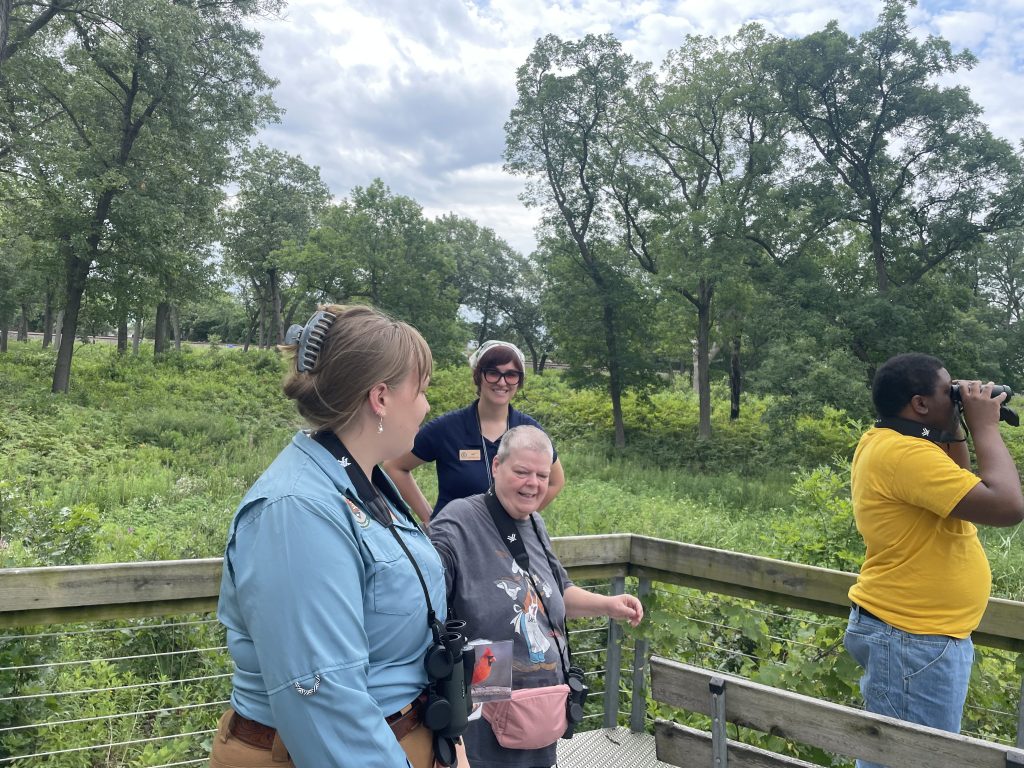
Two of their clients were interested in attending and made the thirty-minute trip out to Gary, which was incredibly meaningful for us. They were joined by two staff members, care aids Teresa and Paige, who were unaware of the Douglas Center before attending the event. One of the clients, whom I won’t name here for privacy reasons, thanked us profusely for putting the celebration together and for the invitation.

The Main Event
Due to the success of our pilot event, we decided to follow the same activity plan with a few modifications. The bird walk remained on the Douglas Loop, but this time, it began inside the center at the windows, where attendees calibrated their binoculars to see the birds at the feeders. We also added pre-determined stops at specific locations, with talking points prepared by Leilany about the birds, insects, and other wildlife of Miller Woods. Adelaide created poison-ivy identification cards, though she and I had manually cut back a lot of it the week before in preparation for the event.
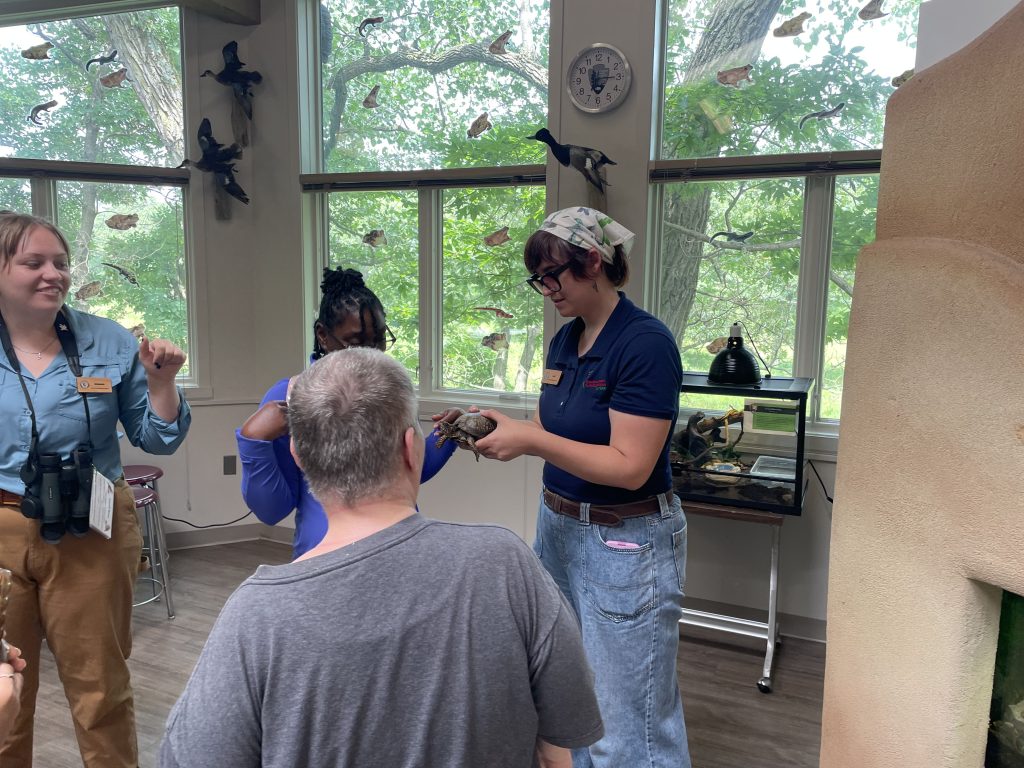
We didn’t make any alterations to the craft or animal room programming, as both were thoroughly enjoyed by the pilot group. But we did change the order. After the bird walk was complete, we took a break for lunch. Then, we went straight into the craft room and followed with interpretation in the animal room. This allowed the crafts that involved glue to dry.
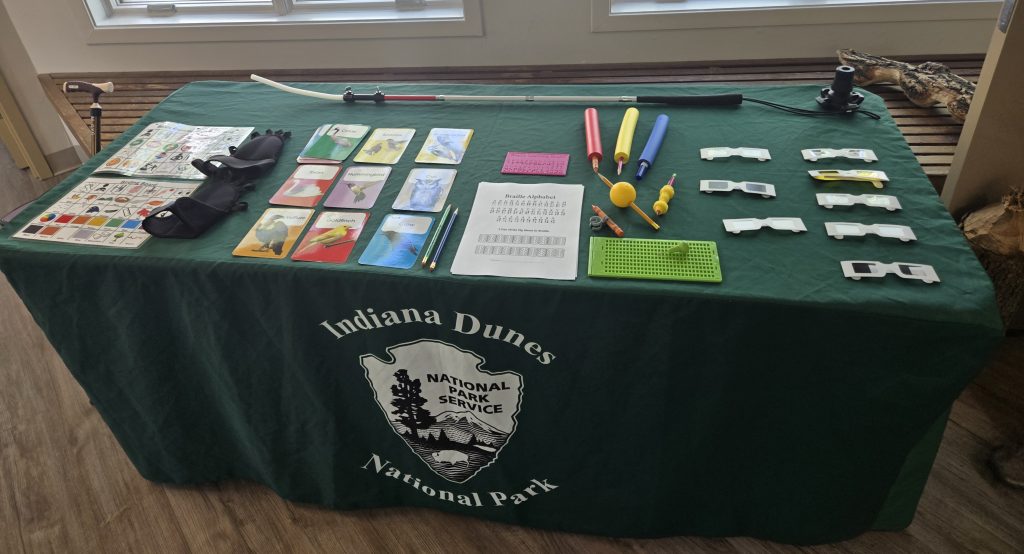
Aside from the ten pre-registered attendees from both organizations, we also had 58 walk-ins to the Douglas Center that engaged with our programming in a variety of ways. One walk-in visitor was a child with albinism; her father used the eye-disease simulation glasses to show her sister how she sees. He was also interested in getting her an Access Pass and an all-terrain cane when she is older. Seeing our accessibility pop-up provide meaningful tools to a family in real time was a reminder of how impactful inclusive interpretation can be.
Hosting events like our World Migratory Bird Day celebrations has been such a blessing in so many ways. Sure, I’ve developed my outreach skills and learned a lot about event planning and logistics. But it’s also more than that. With the team here at the Indiana Dunes, we connected people with nature who may never have had the opportunity otherwise. We showed them that birding doesn’t require thousands of dollars in equipment or an encyclopedic knowledge of local species. We said, “This park is for everyone.”
I’m not sure what I’ll be writing about next time, but I’ve offered to do outreach visits to Paladin, Opportunity Enterprises, and a few other local organizations until I leave in September. Maybe the World Migratory Bird Day programming will continue. Either way, I made sure to make each organization aware of the Indiana Dunes’ education programming. There is so much to enjoy at the Dunes, even after my time here is complete.
Till next time,
Karli
Sorry, the comment form is closed at this time.