


25 Aug Accessibility in Action: ASL, Access Passes, and Adaptive Birding Tools
Greetings, everyone!
Last time I posted, I spoke about the World Migratory Bird Day event we facilitated at Camp Lakeside. This time, I will be discussing some of the materials I created for our events and pop-ups, as well as an accessibility aid we have at our park.
To start, I want to give a shout-out to my fellow Let’s Go Birding interns, Gabe Dominguez and Maizy Wilcox, two Gallaudet University students who have been doing wonderful work at George Washington Memorial Parkway this summer. During our training at Rocky Mountain National Park in May, Gabe and Maizy taught us the ASL signs for a few common birds, such as chickens, ducks, and owls.
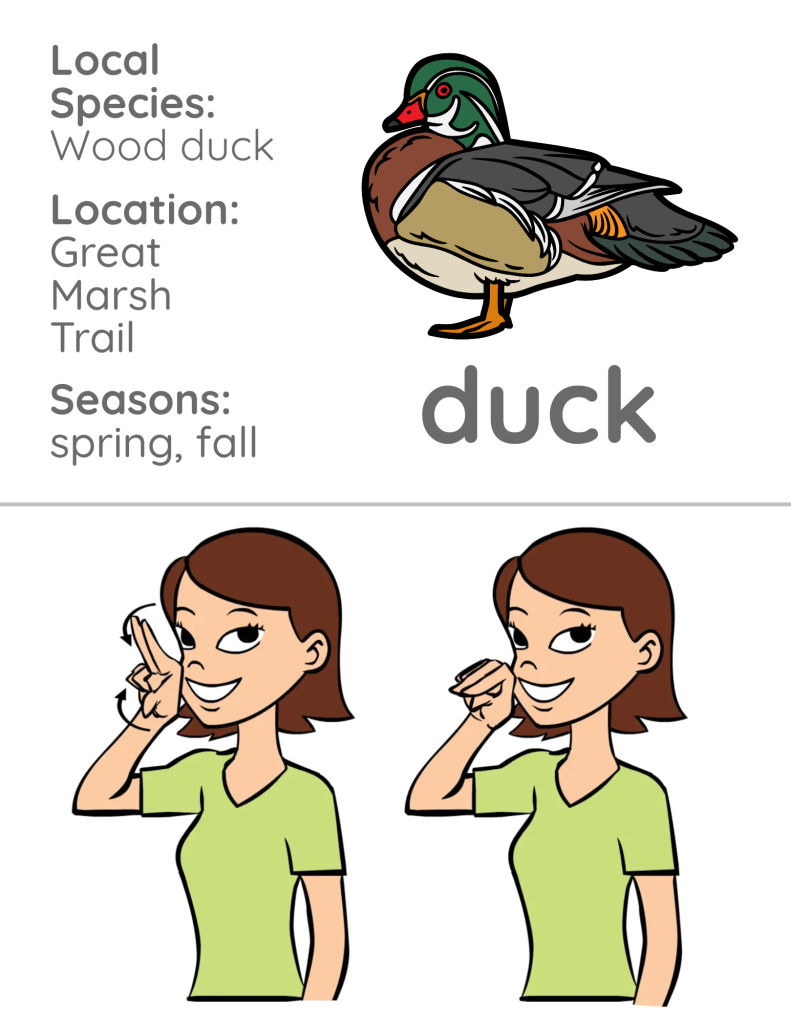
I was inspired by their instructions to create a pop-up activity called “Birds in Sign: Learn ASL with Indiana Dunes!” I made flashcards with pictures of different species of birds that can be found at Indiana Dunes National Park, their location and active seasons, and the general sign for that bird on the other side of the card. During pop-ups, I also displayed a laminated ASL alphabet and a unigrid with bird icons, showing visitors where these bird species can be found visually. The best part about this activity is that it can be customized to fit bird species at other parks. You can see a few examples below.


I also created a flyer about the Access Pass with a QR code linking to the National Park Service website’s page with information about the pass. Before this, we had printed out and laminated the webpage here to provide information about the pass during our pop-ups. But we quickly realized that it would be more accessible to provide a QR code that visitors could use to immediately open the page on their phone and look at later, rather than hoping that they’d remember to look into it after spending a day at the beach. You can see the flyer below.

This is just the tip of the iceberg as far as our pop-up materials go. But now, I’d like to talk about an aid we acquired for the park that made birding more accessible for me.
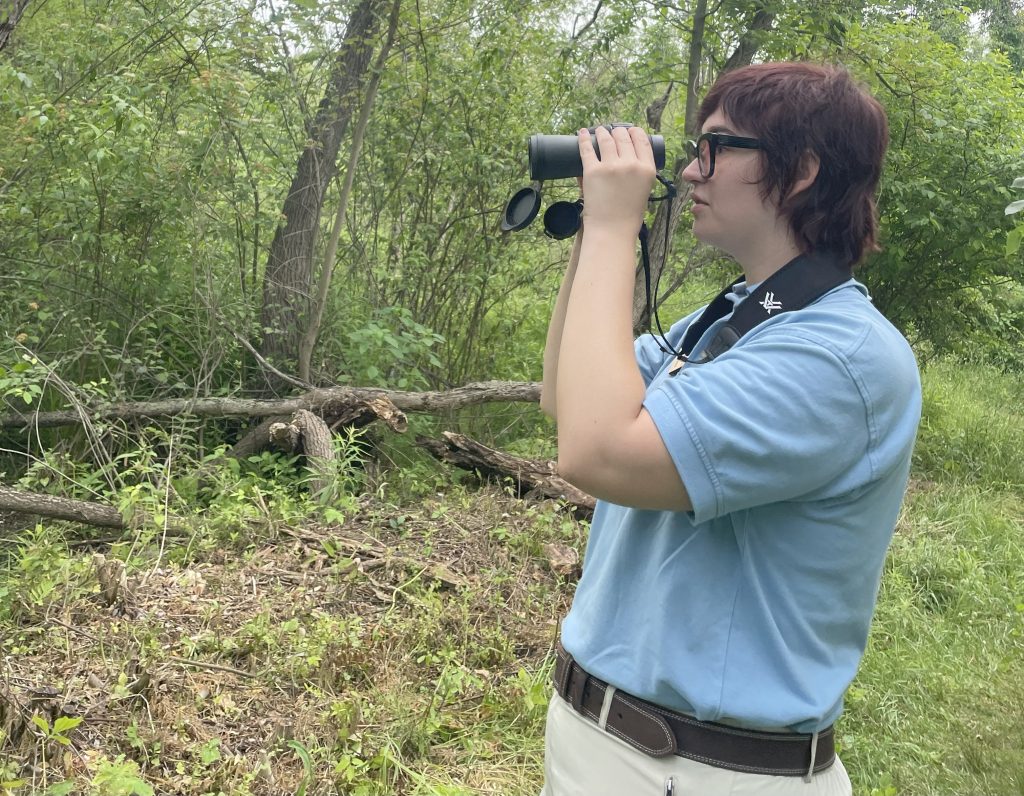
As part of our orientation at Rocky, EFTA provided each of the interns with Vortex Diamondback binoculars (which I am using in the picture below during a bird walk at the Great Marsh Trail). But every time I would lift the pair of binoculars to my eyes, no matter how well-calibrated they were, I would get nauseous and dizzy. I realized that to avoid this uncomfortable symptom, I would have to close one of my eyes while looking through them.
When we heard that EFTA had some additional funding set aside to buy supplies for the park, we decided to utilize some of that money to get a Vortex SOLO® Monocular, pictured below. From that point on, I would use the monocular during our weekly birding program every Wednesday, and I stopped experiencing the dizziness and nausea that had prevented me from enjoying the variety of bird life at every trail we visited.

Now, even as I complete the rest of my internship remotely, the monocular remains at the Paul H. Douglas Center for visitors to borrow when needed. I hope it can help others enjoy birding like it did for me!
Well, that’s all I have for now. But next time, I’ll discuss my favorite part of the internship overall. I anticipate that this will be quite a challenge, as there are too many amazing experiences to choose from. It’s a good thing I have time to narrow it down.
Til next time!
Karli
Sorry, the comment form is closed at this time.