


11 Sep Light Pollution and Bird Migration
Right now, an avian river flies above us each night as nature exhales billions of migratory birds from breeding grounds in Canada and the United States to the warmer climes of Mexico, Central America and the South American continent. It’s the spectacle of fall migration and more than 80% of North America’s birds partake in it. Of those, 70% travel at night. Nearly all are passerines (perching birds). Evolution has chosen their nocturnal journey to keep them safe from volatile weather and hungry predators. But now they have an even deadlier foe: Artificial light
Nighttime light pollution is a siren’s song for migrating birds. Its attraction causes them to fly off course, resulting in both disorientation and depleting their precious fat reserves. The outcome is birds that are in the wrong place and the wrong time surrounded by a highly dangerous environment. In urban centers window strikes are the greatest threat, creating death and injury through mass collisions. However, while cities get most of the attention, suburban and rural nocturnal lighting actually cause most bird deaths because they’re more numerous. Estimates have determined that the average single family home kills 1 -3 birds each year. In total, that means urban, suburban and rural nocturnal lighting results in up to 988 million bird deaths in North America alone.
Yet, attraction to light is in birds’ nature. Over the past 66 million years, birds have developed and honed their ability to migrate at night using light cast by the moon, stars and planets with extreme accuracy. Much of it has to do with the physiology of the avian eye. Unlike the ocular ability of mammals, birds’ eyes process images at much higher speeds. Here’s an example. The average incandescent office light pulses between 100 – 120 times per second. Human eyes can’t perceive this. But birds’ eyes can. Even greater, birds can see the movement of stars, planets and the moon as they happen in real time, greatly heightening their migratory accuracy. That is, unless a stronger light source gets in the way.
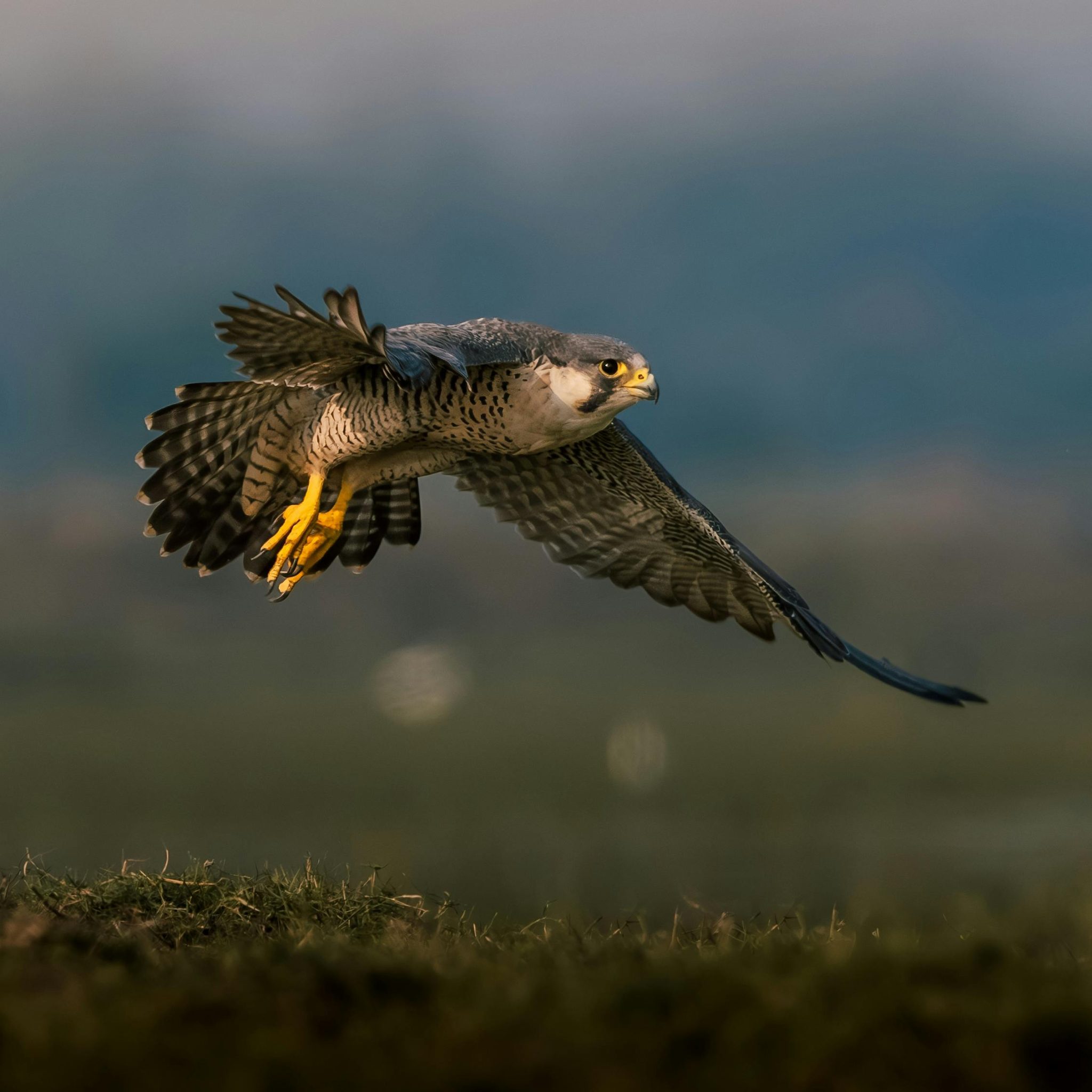
With the focus on the perils of artificial light upon nocturnal songbird migration, it’s easy to miss how it affects diurnal (daytime) migrants such as the Peregrine Falcon. “Peregrine” means “wanderer” and it’s an appropriate name for this iconic raptor. Peregrine Falcons breed on every continent, save Antarctica. And their migration is epic. Peregrines that winter in South America may travel as far as 25,000 km (15,500 mi) in a single year.
Since their recovery from the pesticide DDT, many Peregrine Falcons have traded in their natural alpine nesting sites for the high altitude of urban office buildings. It’s a natural fit….until night comes. That’s when Peregrines are attracted to songbirds unnaturally congregating in artificial light. Yet their very way of hunting is often a death sentence. Peregrine Falcons hunt from above, spying songbirds, then pouncing upon them in a dive clocked at up to 230mph. In an open environment, a miss is unfortunate…but not fatal. Surrounded by 30-story buildings, it’s easy to see how a failed attempt at dinner can result in death.
Luckily, we can all do our part to make a difference - And it's pretty simple
Turn off non-essential lights from 11 PM until 6 AM between now and Oct. 31st. .
- Turn off or dim lobby and atrium lights.
- Turn off or dim interior home lighting or draw blinds to prevent light escaping.
- Turn off decorative landscape lighting.
- Turn off lights before leaving the home or office.
- Be sure outside lights are aimed down and well shielded.
- Install motion sensors on outside lights to minimize use.
- Along with telling your friends, family and neighbors to do the same thing!
Sources
What You Should Know About Bird Migration and Light Pollution | DarkSky International
https://www.audubon.org/our-work/cities-and-towns/lights-out
https://www.audubon.org/magazine/window-strikes-are-even-deadlier-birds-we-thought
https://www.allaboutbirds.org/guide/Peregrine_Falcon
https://birdsoftheworld.org/bow/species/perfal/cur/introduction
Carol Ritchie
Posted at 11:02h, 15 SeptemberI’m hoping this issue on lighting is being sent to State and Municipal governments across America. I live in Canada where FIBALLY we were successful in pushing the languishing Migratory Birds Legislation forward into Law!!
Our local Municipality in Ontario had put out a message regarding their plans
s to “improve” the outdoor lighting of an iconic rail bridge that spans our local Heritage River. I had some information that I dispatched to them on downcast lighting and the 3000 Lumens and TOTAL AVOIDANCE OF BLUE LIGHTS, rule
. Of course I received the usual boiler plate “thank-you’s about about “being concerned citizen – BLAH!!
Anyway it might be a good idea to at least try to politely (after All I AM Canadian – LOL) advise as many Munis. and States as possible.