


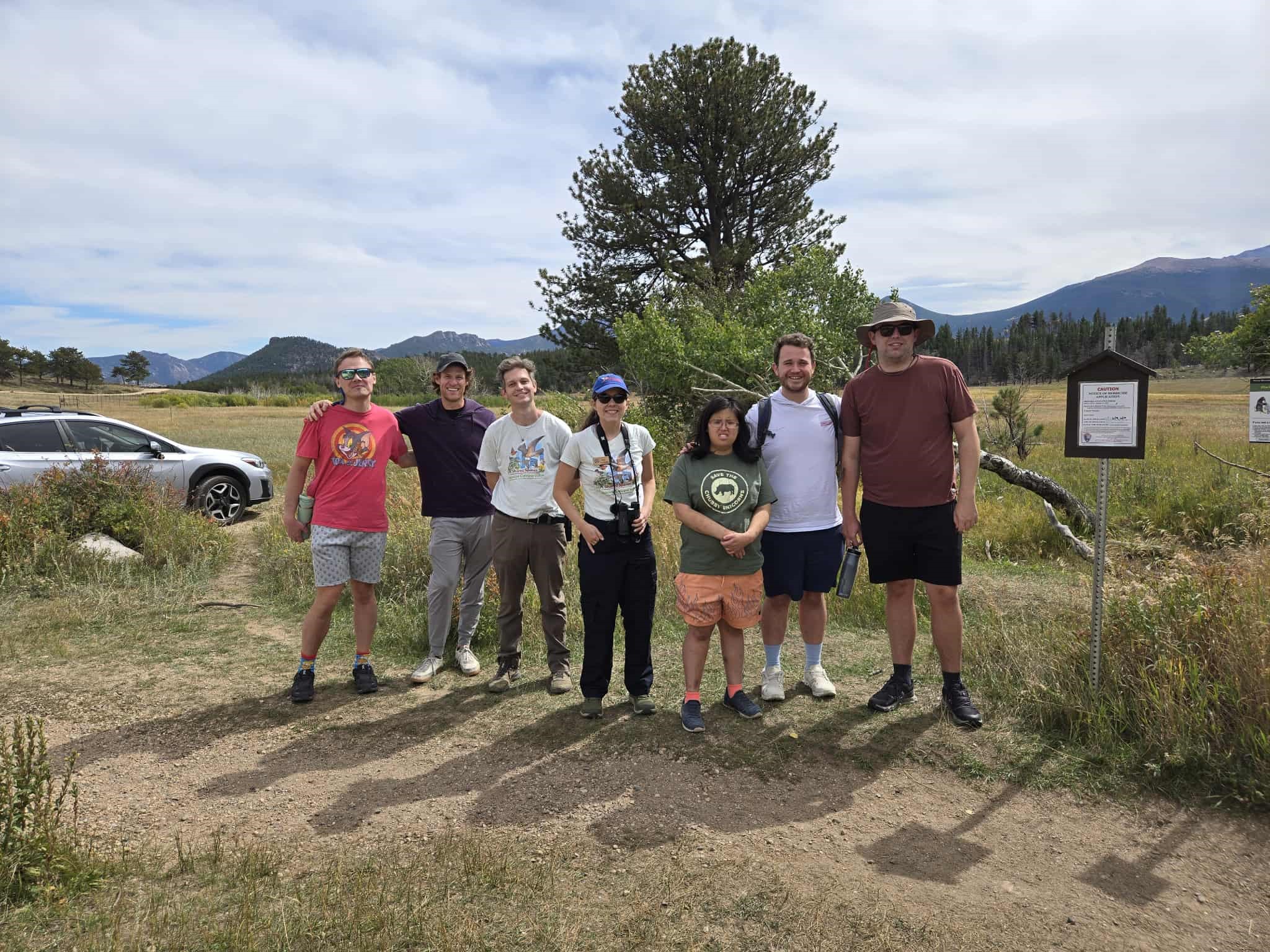
25 Sep Rocky Mountain National Park – World Migratory Bird Day Main Event
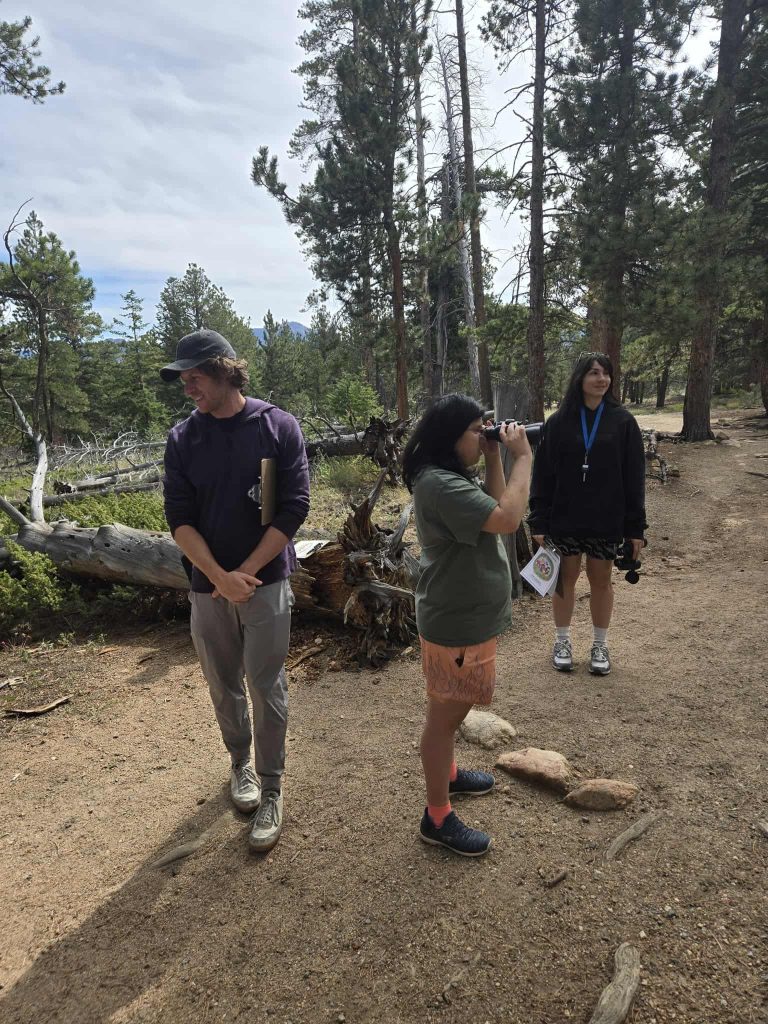
We have all been waiting for the World Migratory Bird Day Main Event hosted by the Let’s Go Birding interns, Irlanda Moreno and Connor Chilton, at Rocky Mountain National Park. With the success of our first WMBD event with REVEL, they returned to enjoy the highlights of birding in the fall at the Upper Beaver Meadow loop trailhead. We had 11 participants, including 8 REVEL clients and 3 staff members. Each obtained a copy of the official Cornell Lab Explorers Guidebook, which was provided by our wonderful supervisor, Emily. For this event, the guidebook contained activities for the participants, such as looking for clues in terms of what makes a good habitat for birds and listing various bird species according to certain traits they have. The overall goal was to put the participants in the shoes of a birder and use step-by-step instructions with visuals to aid in bird identification.
Stop one – Record what you hear
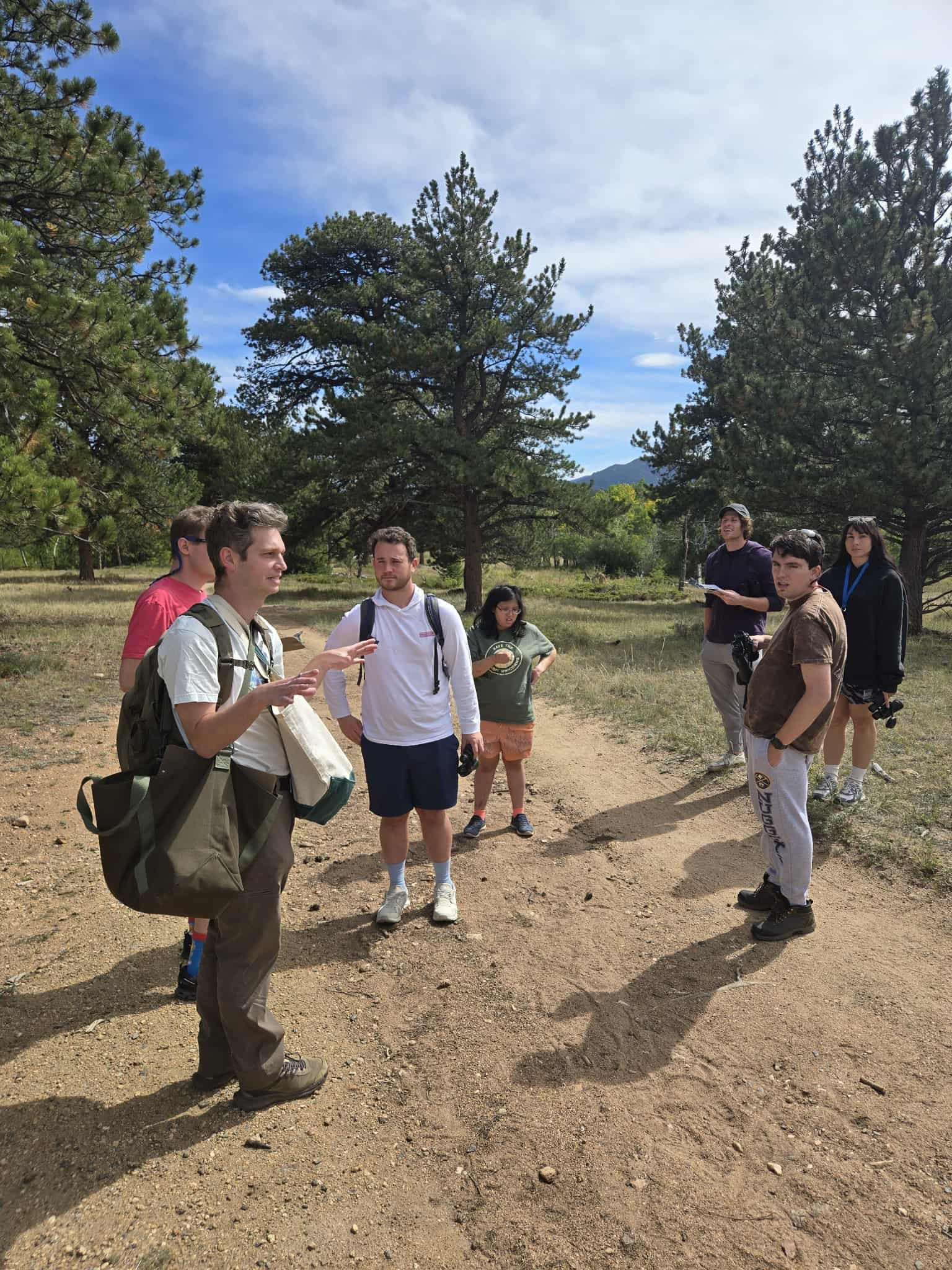
Our first activity had the participants take a moment and observe what they are currently listening to in nature. Ranging from the wind, bird sounds, and other animals. As everyone was listening to different sounds, they recorded them in their guidebooks. One REVELer heard the faint sound of a cricket, as I did not pick up the sound myself. Due to the changing seasons from summer to fall, it is the elk rut for us in Rocky Mountain National Park. We heard a faint elk bugle call from afar, which resonated throughout the valley. Connor explained what sounds we can possibly hear from birds, such as ducks quacking and owls hooting. We utilized the Audubon sound Mallard and Great Horned Owl plush toys for the REVELers to get an idea of what different bird calls sound like.
Birds were somewhat scarce at the beginning of our walk, but as we descended further on the trail, we spotted a female elk sitting off the side of the trail, where I mentioned the rule of thumb for keeping a safe distance from wildlife. I showed them to extend their thumb out, and if their thumb covers the animal, you have enough space between yourself and the wildlife.
Stop two – Habitats for birds
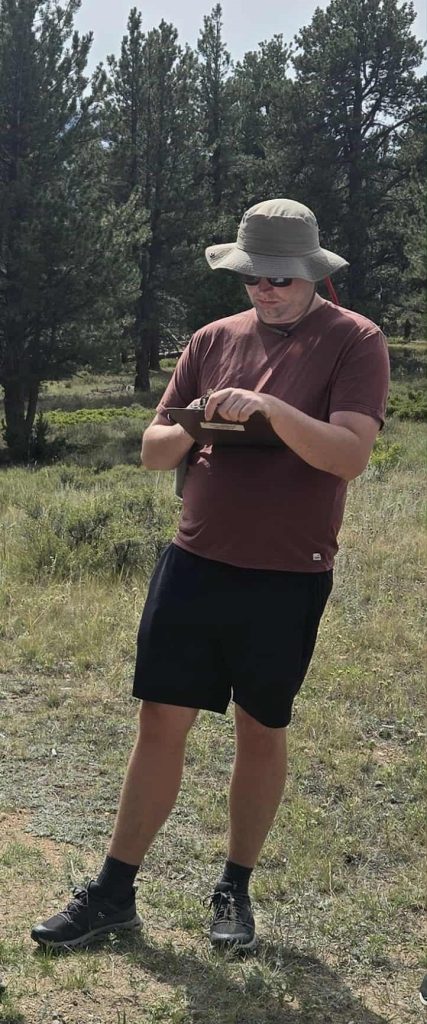
The participants had two pages in their guidebooks with checklists in order to find any clues in their surroundings to determine if we have a great habitat for birds. The options included finding insects, water, nesting material on the ground, and feathers, to name a few. I asked the group two questions in relation to ourselves and birds:
What do birds need to survive?
What do people need to survive?
The participants enthusiastically answered food, water, a place to call home, and large areas of space. This was my personal favorite activity because it allowed the REVELers to explore the area at their own pace without having to listen to Connor and me present for a long period of time in one place. I was keeping a watchful eye on everyone because each client had different learning capabilities, whether they are comfortable sitting or need more time to move around. One of the participants looked at the nearby trees and found ants, which provide food for woodpeckers. Someone saw animal tracks as a telltale sign of an active wildlife area. We spotted a couple of Steller’s Jays seen in the trees, which checked off trees and branches as places to find birds. There was plenty of open space for birds to have enough room to take flight. However, one REVEL client said aloud one important clue that is missing in the area on our list. No water! Therefore, I asked the group, “What could this mean about this specific area”?
It means that the area we were in could be a temporary spot for some bird species that are possibly passing through. I shared with everyone that we definitely have one thing in common with birds: we need water.
Stop three – Birds of various shapes and sizes
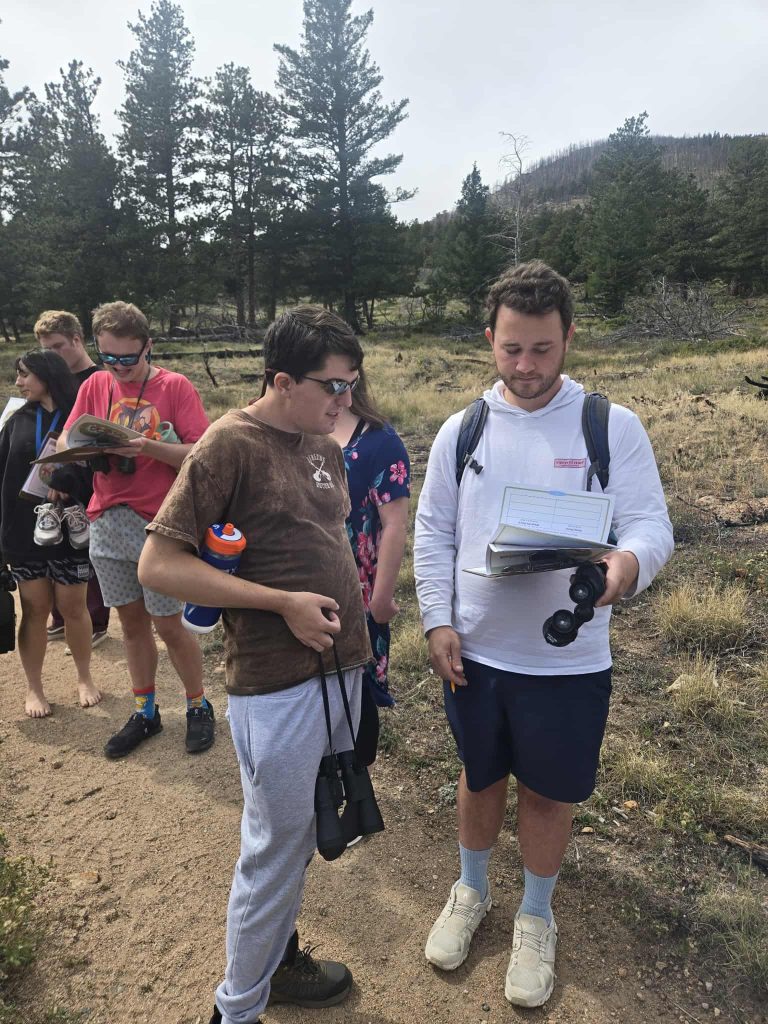
At our third stop, we asked everyone about the biggest animals they could think of. Answers varied from elephant, ostrich, whale, etc. Connor shared with everyone that birds come in all shapes and sizes. The world’s biggest bird is the ostrich, at roughly 9 feet tall and weighing over 300 pounds. That is double the height and weight of a full-grown man! As for the smallest bird in the world, the bee hummingbird from Cuba is no bigger than your thumb and weighs the same as two paperclips!
For this activity, the participants looked at different bird silhouettes to match a bird we saw on our walk, such as the Steller’s jay. We decided the Steller’s jay is roughly around the size of a robin on the scale and with a shape similar to a crow. Hence, they are closely related to crows and ravens. A color palette was also shown in the guidebook to identify the colors of the birds sighted.
In addition, a REVEL staff member pointed to two small birds. Unfortunately, we were not able to identify those birds as they were very far away, even with binoculars. However, this was the perfect time to use the bird size scale in the book because, despite not knowing what specific birds they were, we used the scale in our books to determine that they could be potentially songbirds, such as a finch or sparrow.
Stop four – Birders have holidays too
As this year is coming to an end, we asked everyone, “What holiday are you looking forward to most?” Connor mentioned that even birders have holidays too. We discussed the official World Migratory Bird Day in October, where birders can meet with one another and share their findings and passions about birds. In the guidebook, the REVELers filled out what bird species they saw during our hike. We saw the Steller’s jay, pine siskins, and chickadees, to name a few.
Some people in our group were not sure of every bird species they saw; therefore, we utilized the bird silhouettes to identify which group they could potentially be in. I took note when the participants started checking the time on their phones, and I shared with everyone the app, eBird. This helpful app on our phones keeps track of your bird count without the need for a physical notepad. Not only can we keep track of the number of birds, but our findings are shown to science institutes and are shared with other fellow birders.
Conclusion – Thoughts
This summer with REVEL was very fulfilling because this was the first time I hosted accessible bird walks with a neurodivergent organization I am with. It made me feel empowered to show REVEL that birding is for everyone and that I am willing to adjust how I educate people. I learned so much from this group in regards to understanding and meeting everyone’s needs while still promoting an impactful bird outing. The Cornell Lab Explorers Guidebook is an exceptionally helpful resource for all ages and abilities. The link to the guidebook can be found on the bottom of the page.
During the pilot event, I especially kept a close eye on the REVELers and while they did enjoy our first bird walk, I am always looking to improve my guided walks. I took note how restless the attendees felt as they needed more time to walk which I acknowledged and used to my advantage. I did see the passion for birding in the REVELers and changed my method of presenting from less time talking to more time walking with an activity. The results from the main event showed the participants were a lot more engaged and able to grasp the content.
I hope to continue promoting accessible bird walks as they are meaningful, learning experiences for both the guests and the interns in the near future.
Sorry, the comment form is closed at this time.