


04 Dec My Favorite Project (So Far): Designing an Aquatic Organism Passageway
My favorite project that I have worked on so far as a resource assistant has been designing an aquatic organism passage, also known as a fish culvert.
Background: Culverts vs. Fish Culverts
Besides bridges, there are several methods for building a road over a stream or body of water, depending on the stream’s size and its potential for flooding. For roadside ditches or small ephemeral streams with no aquatic life, sometimes a pipe or other type of man-made channel under the road to carry the water beneath the road surface can be effective. This kind of structure is called a culvert.
A fish culvert, or aquatic organism passageway (AOP), is a type of large culvert that maintains the original shape of the stream bed and channel. They are used for streams that host aquatic life but are still small enough not to require a bridge. See below for the difference – these are pictures of the same stream, a few hundred feet apart. The AOP above clearly allows for regular stream functioning, whereas the pipe culvert below poses an obstacle to fish passage.
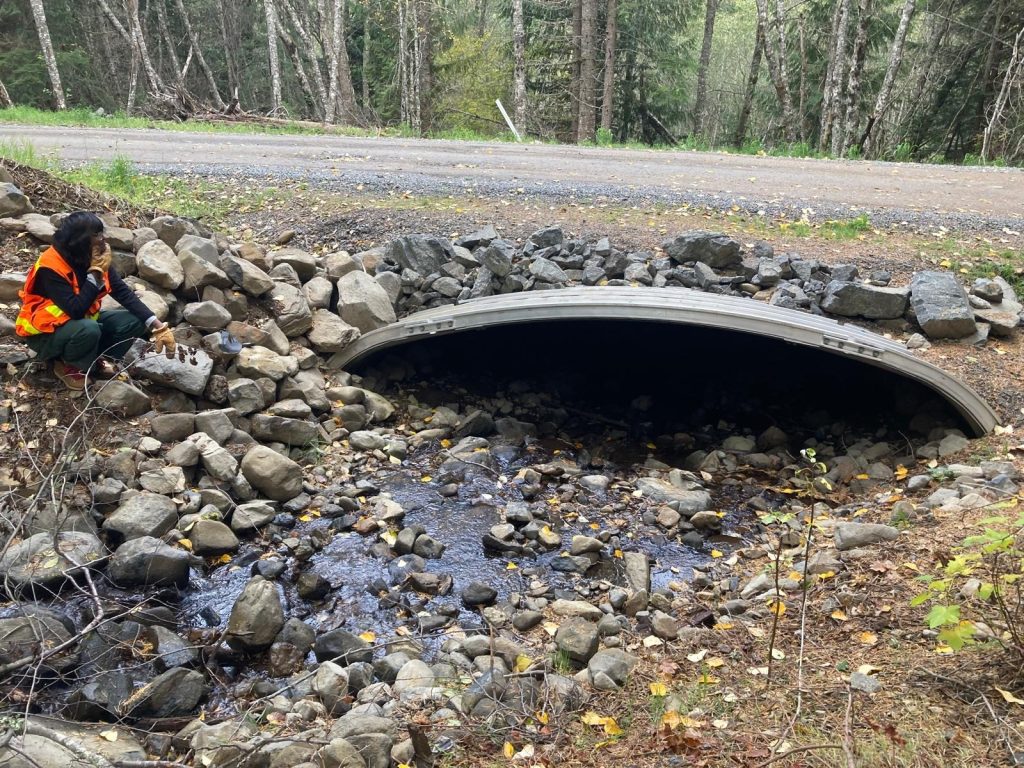
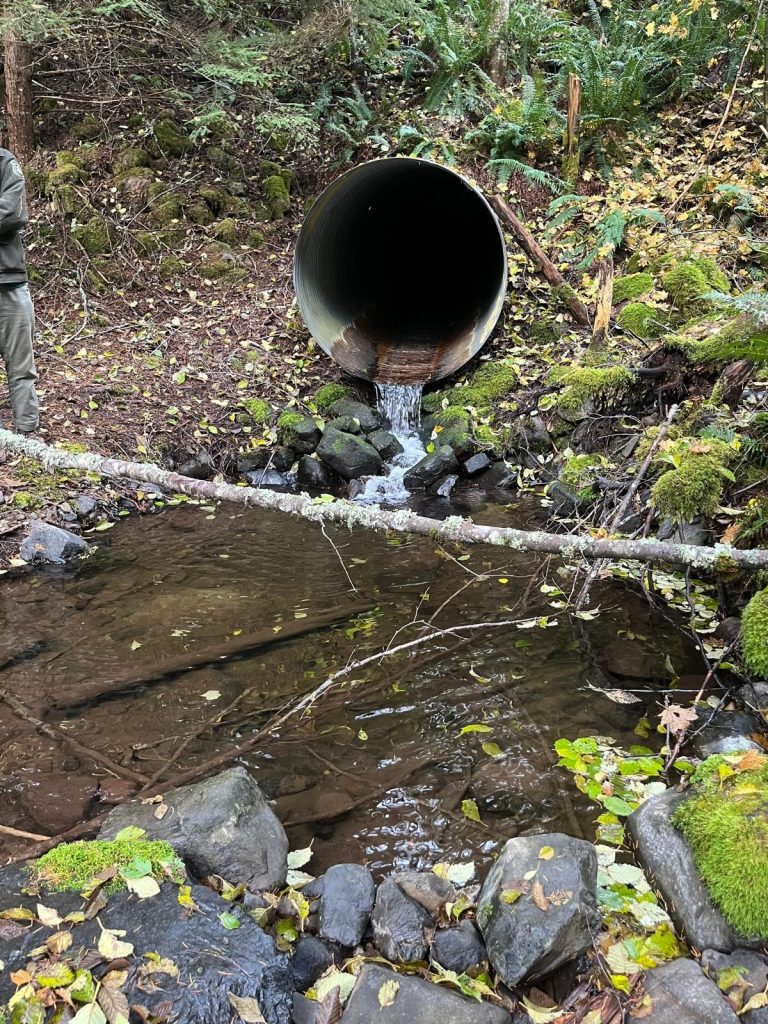
The same stream at two different road crossings a few hundred feet apart. Above: an AOP. Below: a regular culvert.
This Project: Stream Restoration & AOP
Since pipe culverts are typically much cheaper than fish culverts, they have sometimes been used in streams that actually contain fish or other aquatic life in the past. This has resulted in large stretches of habitat becoming inaccessible to anadromous fish species. In the photos above, the AOP is a recent installation; a few years ago, it was a pipe culvert that looked and functioned just the same as the pipe on the right, not allowing fish passage. The project I am working on involves repeating the restoration process from the pipe culvert to the AOP for the crossing shown in the other picture. This involves removing the existing pipe, reconstructing the stream beneath the road, and installing a large arch culvert structure that will allow for fish passage.
The Design Process
To begin a complex project such as this one, we first needed to do a survey of the existing ground and topography. We conducted this survey using a Total Station Survey (TSS), a device that captures points on the ground and assigns them x, y, and z coordinates to map their relationships and form a comprehensive 3D model of the area. This was my first time doing this kind of survey – thankfully, we had more experienced engineers who were able to guide us through using the TSS. The entire survey process took about three days.
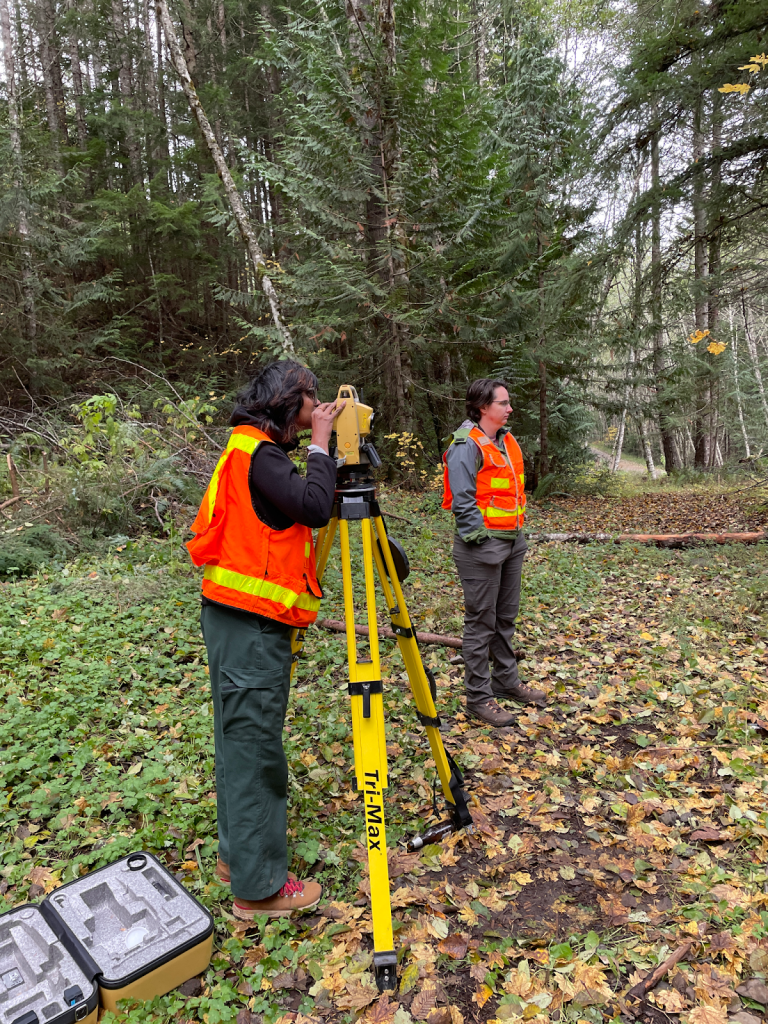
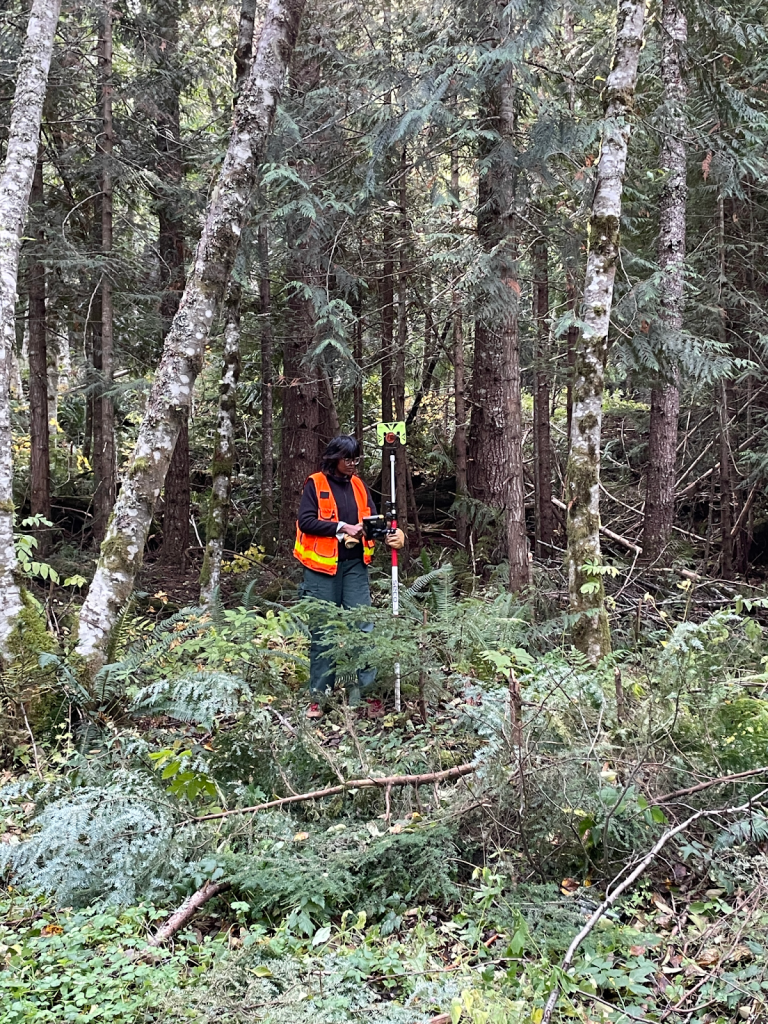
This part of the project, in particular, was a valuable experience for me, as someone who had previously only worked on the design side of engineering. Usually, I enter a project by receiving survey data from someone else and then proceed from there, sometimes starting the design process without having visited the project site. Being involved in the survey myself was so educational and gave me a much better understanding of the area. One of the most professionally rewarding aspects of working for the Forest Service has been the expansion of my experience. In government, we are involved from start to finish in selecting a project, conducting surveys, designing plans, preparing contracts, and overseeing construction. If I were working in the private sector, I would probably have little or no contact with most of these processes at my level. Gaining these experiences has made me significantly more confident in myself as both an engineer and a professional.
After the survey was complete, I uploaded the collected data to a modeling software called AutoCAD to create the actual AOP design and draft construction plans. The ecological element of stream restoration made this project unlike anything I’d worked on before. Along with the objective mathematical questions that accompany any work of civil engineering, we also had to consider more qualitative aspects of the design, namely, how to artificially reconstruct a stream to match its natural form as closely as possible. This involved considering factors such as the shape and structure of the existing stream, the sizes of rocks and pebbles, and the width and slope of the stream. With all of the new concepts and the interdisciplinary nature of the work, I was grateful for the guidance of more experienced engineers. We also consulted with the forest hydrologist for this project.
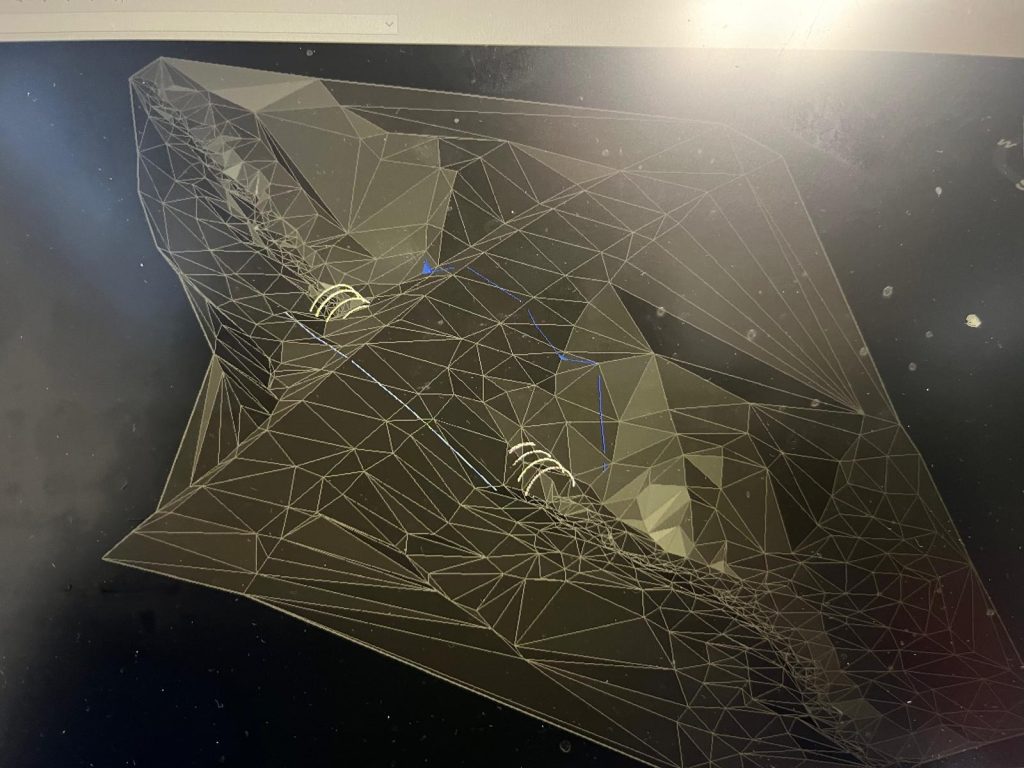
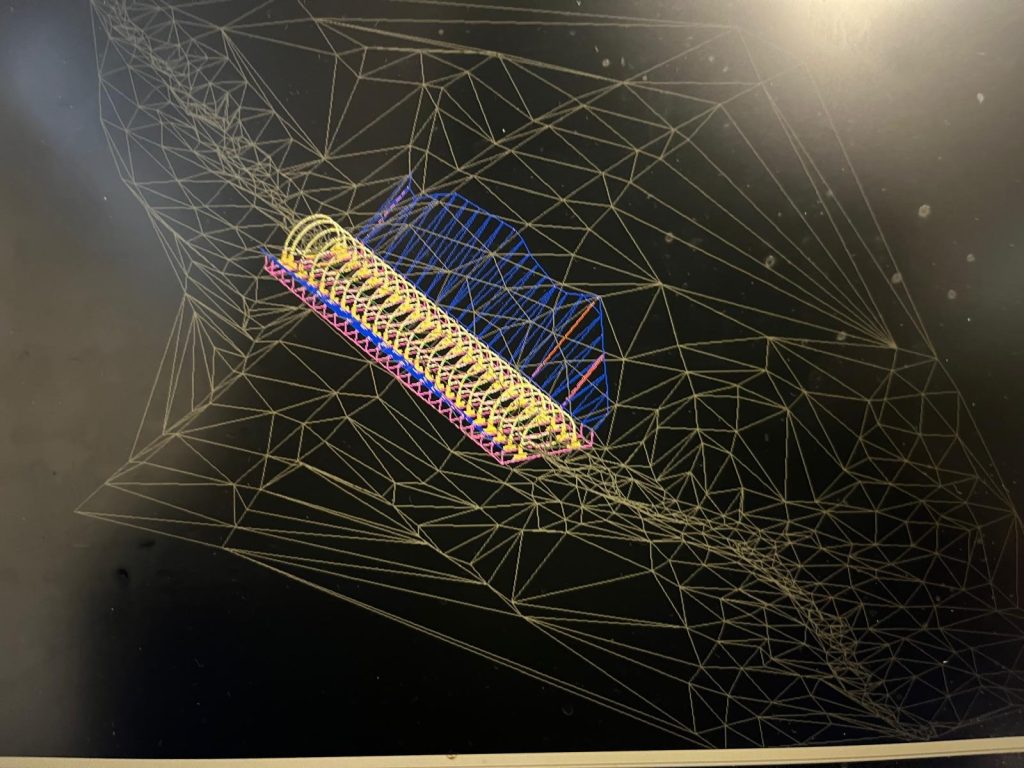
My CAD model of the project site and planned structure. At around 18 feet tall, 9 feet wide, and 100 feet long (!), the culvert will offer plenty of space for fish to cross the road and explore previously inaccessible habitat.
Next Steps & Personal Reflections
After the designing and drafting are complete, the next steps will be to estimate costs, put together a contract, acquire funding, and then finally oversee construction. I’m not sure if I will still be with the Forest Service when this project finds funding, but I’m glad to have provided the design work to at least get it started. This project has been paradigmatic of all my favorite aspects of this internship – not only did I learn a lot, but I also got to use my time and talents to work towards a slightly better world (i.e., one with more fish). I’ve always found the interactions between the built and natural world to be the most interesting part of civil engineering – how do we live in the world and build roads to get around without negatively impacting the plants and animals with whom we share space? Salmon and anadromous fish are particularly important to the environment and people of the Pacific Northwest. Part of the push toward AOPs has been through the efforts of local Tribes to recover lost habitat and mitigate the effects of urbanization. Projects like these make me excited about a world where we can create better designs that more harmoniously integrate human needs with environmental needs, ones that do not require this kind of retroactive mitigation. I hope that as my career progresses, I can continue on this path of engineering a more sustainable and resilient world.
Sorry, the comment form is closed at this time.