


25 Oct Caves and Wetlands
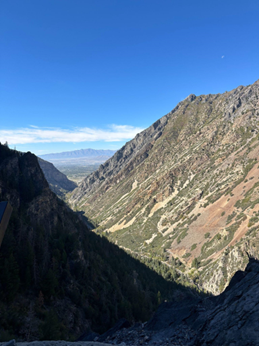
The Bear River Migratory Bird Refuge partners with Timpanogos Cave National Monument and a few other National Park Sites. This week I got the opportunity to visit and tour Timpanogos Cave with my fellow interns. I have lived in Utah my entire life, love hiking and natural land formations, and my parents even got engaged at Timpanogos Cave, yet I have only been there once, when I was young enough to think 1.5 miles was way too far for me to hike. And it was; I was exhausted, and I remember complaining the whole time while my brother walked alongside me and my sister was tossed around in a carrier on my dad’s back. This year, 1.5 miles and 1,100 ft of elevation gain was almost a piece of cake; it’s practically switchbacks all the way up the side of a mountain, so there was bound to be some huffing and puffing.
At the top, a lookout point marks the start of the cave tours. A tour guide will bring you and your group inside the first cave known as Hansen’s Cave. Martin Hansen first discovered the cave back in October of 1887. According to our guide, he was out in the American Fork Canyon mountain range chopping down trees when he saw a mountain lion. He was able to follow the tracks of the large cat up the mountain to the mouth of this cave. Later, he returned with the proper tools and materials not only to explore, but to mine as well.
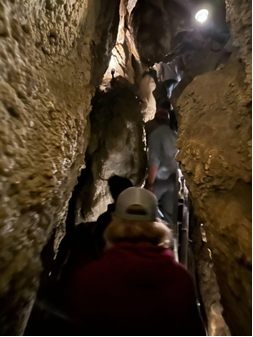
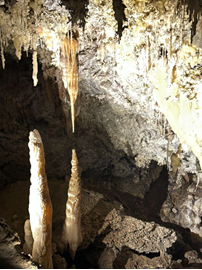
When you first enter Hansen’s cave, you are surrounded on either side by layers of Flowstone; a mineral deposit formed on cave walls or floors by sheets of slowly flowing water. The water starts as rain or snowmelt that seeps through the mountain and into openings like caves. As it flows through the mountain, it collects minerals such as calcite and iron, causing different colors to appear.
Over time, Hansen’s Cave became heavily affected by human activity, and it’s still visible when you enter the cave today. Pictures from when the cave was first discovered show an untouched wall of flowstone, while today, if you visit, you can see the impact humans have made. Crumbled rock piles up on the floor, and writing appears on the cavern walls. While the effects humans have had on this cave are disheartening, they also led to the protection of Timpanogos Cave.
James W. Gough and Frank Johnson first discovered Timpanogos Cave when they were just teenagers. From a family of miners, the two boys discovered the cave and immediately began planning. They left a box of dynamite just inside the entrance and covered the opening with rocks to hide their raw fortune, disguising the entrance so well they wouldn’t be able to find it again.
It wasn’t until 8 years later, August 14, 1921, when Vearl Manwill and a group of friends set out on a mission to find a hidden cave rumored to be near Hansen’s Cave. While searching the mountainside, Manwill noticed an oddly shaped pile of rocks, but the shape wasn’t the only odd thing about these rocks. As he ventured closer and raised his hand to the pile, he felt a cold breeze coming from the other side. He and his group removed the rocks to find an opening, so dark they couldn’t see the bottom, the top, or anything else besides a box of dynamite that had been sitting there for the last 8 years. They used carbide gas headlamps and hundreds of feet of rope to explore the darkness, and when they returned to the surface, it was decided they needed to find a way to keep this cave from being gutted like the last. That night the Payson Alpine Club was created.
About two months later, on October 15, 1921, Martin Hansen’s son and grandson, George Heber Hansen and Wayne Hansen, discovered Middle Cave. Talk about keeping it in the family. The pair were out hunting when they spotted another opening next to “Grandpa’s Cave” from across the canyon. They immediately switched from hunting to caving and climbed up the mountain with approximately 60 feet of rope, carbide lamps, and a dream. The dream being they only needed 60 feet of rope when the drop from the opening was over 100 feet. Dream or not, they made it to the bottom of the cave and back out to tell the story, and Middle Cave was now part of the three-cave system we know today.
Just a year after the Middle Cave’s discovery, thanks to the Payson Alpine Club, the Timpanogos Cave system was established as a national monument and therefore off-limits to mining, with a new goal established: to preserve the cave for generations to come. Today, you can visit the caves and take a tour through all three, learning about the cave’s history and the natural processes that took place while it was undiscovered. If you’re ever passing through Utah, I urge you to visit the Bear River Migratory Bird Refuge and discover the beauty of wetlands, then keep going south and learn about the artistry of caves at Timpanogos Cave National Monument; maybe you’ll learn something about Utah’s history as well.
Sorry, the comment form is closed at this time.